In Case of an Emergency
Medical Emergencies
If there is a medical emergency that requires urgent medical attention, please facilitate a visit to either the Urgent Doctors or Emergency Department. If it is life threatening, call and ambulance immediately. Otherwise, call the on-call staff member for advice and guidance. In any case, make sure you advise the staff member on-call of any health issues that occur as soon as possible.
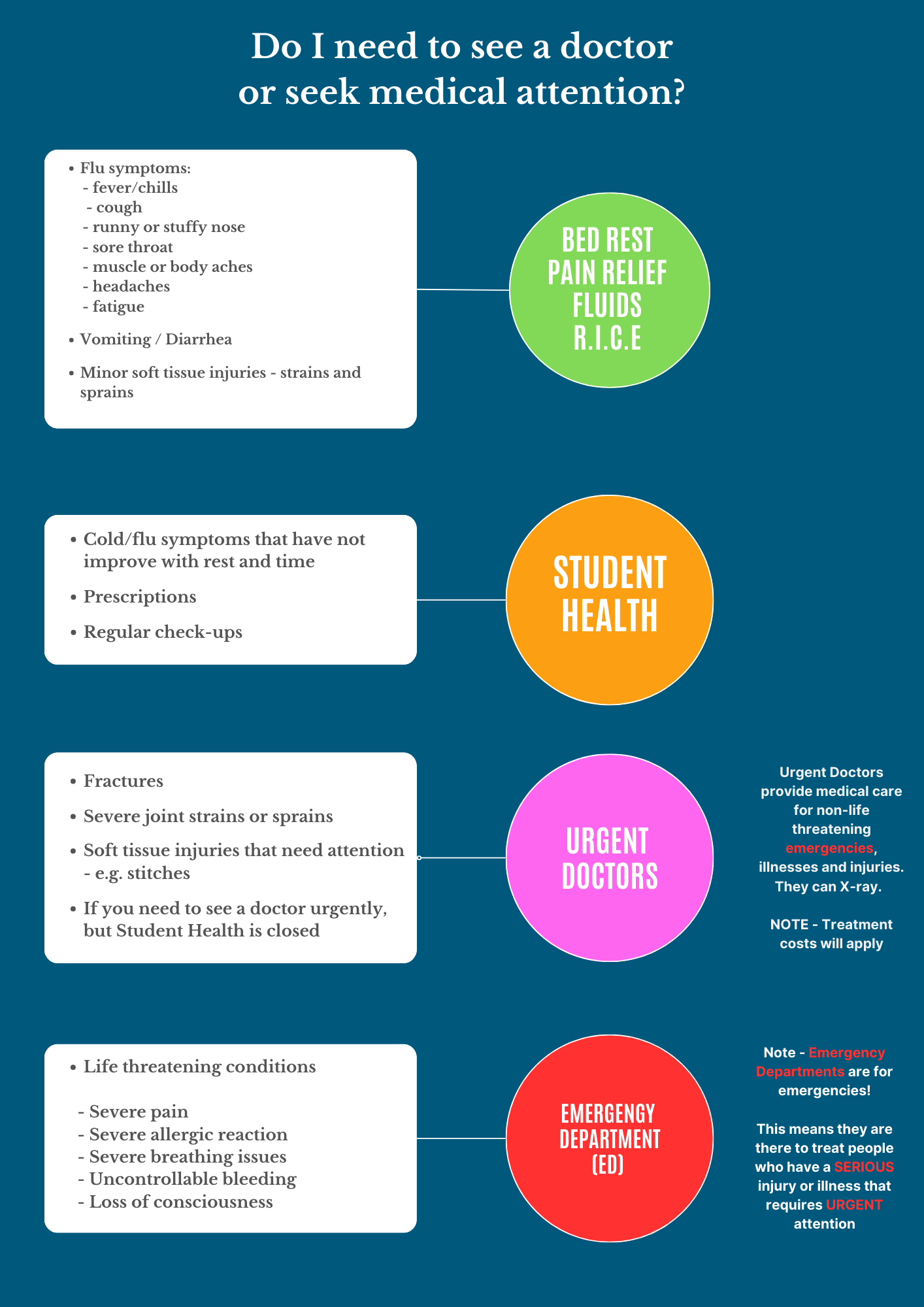
Campus Watch are often available to provide transport for Members to the Urgent Doctors. Alternatively, if a taxi is to be used, there is a black plastic folder containing taxi vouchers in the Administrator’s office. These are like blank cheques so please treat them as such, and do not just hand them out casually to Members. Ensure that you complete the voucher record sheet when giving the voucher, and again upon its return.
College Leaders shouldn’t need to be involved with every minor complaint. In most circumstances, students are quite capable of walking to Student Health by themselves or in the company of friends. Advising Members to call Healthline on 0800 611 116 - or calling for them if you need advice or reassurance - can be a good first step. Seeking advice from the on-call staff member can also be useful if you are unsure how to respond to a Members' illness/presenting symptoms. If there is any element of risk, such as a severe asthma attack or a diabetic seizure, please call the ambulance by dialling 111 immediately.
If a Member requires an ambulance, usually the on-call staff will by be involved and will manage the situation. But if, in the unlikely event that you take someone to hospital, please keep in contact with the College. Parents and College staff can normally get very little information and it is good if you keep in contact. Information is sometimes needed for informing parents, sometimes it helps for academic reasons, and because we are very concerned. To aid in this, please note that each Member has agreed to the College having health information provided to them (they agreed to this when accepting a place at the College). Please keep a listening ear for health issues that Members may be privately discussing with each other as this information may be helpful when deciding what help is needed in a particular situation, for example, somebody who experiences seizures may not necessarily want an ambulance called every time they have a seizure, and they may have mentioned this to you or others in the past.
Suicide threats
College authorities take such threats seriously and there is a protocol for dealing with them. If you hear of any suicide threat or are aware of anyone talking about it, ensure this is dealt with immediately. Remain with the student or ensure a responsible student is left with them, and contact the Head of College or staff member on-call. If no one is available and you believe the student is in immediate danger, call Emergency Psychiatric Services (0800 467 846), first making sure that the student is aware of what you are doing. You must notify the Head of College or the staff member on-call - either in-person, by phone, or Slack - immediately after the event occurs. Dealing with situations such as these can be difficult for you also, so do not hesitate to seek help and/or counselling for yourself if needed.
Death
In case of the death of a student:
- Ring for ambulance, Head of College, and police. From here on, presume that the Head of College is making the calls.
The Head of College will then:
- Contact the police, who will be responsible for informing next of kin.
- Ask the police to give the Head of College's cell phone number to the next of kin and invite the next of kin to call.
- Call Chaplains and the Senior Warden.
- Call Victim Support, which is a 24-hour monitored number on 0800 842 846.
- Inform College Leaders and meet with them to discuss the process.
- Inform the Council President and ask them or someone deputised to handle the media in consultation with the Head of College.
- Be aware of where students are congregating and that they are adequately cared for in those areas.
- Create a focal place for grieving - Library, Music Room, or Academic Common Room. Use photos, LED candles as appropriate.
- Ask someone to call all colleagues and give them details of the school the person was from and what they were studying.
- Liaise with chaplains and next of kin regarding prayer services or wakes.
- Make copies of the grief pamphlet available.
- Call a full College meeting as soon as possible to give information and stop rumours.
- As soon as possible contact the Head of Department and University Administration.
- Have regular briefings with College Leaders.
- Decide memorial arrangements for Members.
- Decide who represents the College at the funeral and who sends flowers.
- If the home is close by, the College should provide transport.
Fire safety
The Deputy Head of College - Academic is also the College Fire Warden and thus is in charge of fire safety. They will schedule at least two fire drills each year. The College Leader on RC is deputised to act as their assistant (Fire Secundus) and oversee fire drills. Each College Leader also acts as the Fire Warden for their floor and is responsible for evacuating their floor. To do this, each corridor has at least one box containing a Fire Warden’s armband, chalk, pen/pencil, small writing pad, and a tally-tag. Please report any sign of damage or tampering with these boxes. The duties and roles in the event of an alarm are outlined in the Appendix. As each room (especially floor kitchens) are individual fire cells, you must ensure that doors are not propped open.
Please make certain that fire doors are always closed on your floors unless they are fitted with electromagnetic holdbacks. As well as raising insurance problems, open fire doors seriously jeopardise the safety of Members.
Fire Doors
Fire and smoke-stop doors are designed to delay the spread of fire between areas and/or prevent smoke from filling evacuation routes. Except for those with magnetic hold-backs, fire doors must not be propped open. Note that this includes all floor kitchen doors.
Please report any apparent faults with fire equipment to the Deputy Head of College - Academic immediately. Note especially any glass missing or broken on the call points.
First aid
First-aid supplies are located in the first-aid cupboard, in the Utilities Room. Ice packs are located in the canteen freezer. Each College Leader also has a smaller first-aid kit and torch in their bedroom. The equipment in these kits is not for frivolous general use of students. Items from the kits are to be dispensed by College Leaders when needed (note that Members must supply their own paracetamol/ibuprofen and other medication). If you find yourself running out of any items from the kits, please inform the College Leader with the First Aid Coordinator portfolio.
Any College Leaders who do not have a current first aid certificate will be provided with formal First Aid training during the College Leaders training programme at the start of the year.
Un-planned power outage
- DON’T PANIC. Members will take their lead from you, so remain calm.
- Remain on your floor unless you are on duty. The College Leader on duty should position themselves in the foyer if they are not already there.
- Refer to Aurora Energy website – it will tell you what areas are currently experiencing power outages — unplanned or expected — and approximately when the power will be restored. Alternatively, phone Aurora Energy on 0800 22 00 05 if the website doesn’t tell you all you need to know.
- Phone the on-call staff if you need advice or further support.
Note
- The fire doors will automatically close (this is by design)
- Emergency lighting will turn on
- Electronic locks in common areas will still operate – the system has approximately a 2-hour battery life.
- Wi-Fi needs electricity to operate, so you will need to use mobile data.