Pastoral Care
General pastoral care
- Keep your eyes peeled for homesick or quiet people. Often homesick people will not open their doors to meet others, making the problem worse. Members of the College who come from overseas may be acutely homesick and not be able to talk about it. Often it is a good idea to get others on the floor to assist shy and homesick people and this is often the start of a good friendship.
- Be alert for eating disorders that will show themselves in various ways. People may miss meals or wear baggy clothing; they may also eat large meals and always go to the bathroom straight away.
- Be alert for signs that people are not sleeping. Some people will keep odd hours and this is part of their new-found freedom, but if you see a combination of odd hours and irritability then be aware of potential problems.
- Sometimes, to get attention, Members will present a problem that is really just an effort to talk to you and to establish some common ground before they reveal the real problem they want to talk to you about.
- Please remember that you cannot and should not solve every problem. The Head of College and Deputy Heads of College can access resources such as Student Health, Counselling and Chaplaincy. All these worries should be brought up at the weekly College Leaders meeting and/or discussed with the Head of College.
- While you should never attempt to convert a Member to a particular religion or denomination, it is important to let them know you care if they enquire about such matters. Please direct them to the chaplaincy notice board for information on local church groups, or to other Members with church affiliations.
- Mental health: this will be addressed in more detail during College Leaders training. However, be aware that mental health problems are common and diverse — you are likely to encounter them in your role as College Leader. Depending on the nature of a particular issue, you will most likely need to discuss the matter with the Head of College.
Cultural issues
St Margaret’s has Members from many different cultures and countries. Because of this, you should act with great sensitivity towards individuals in the College who may have different religious or personal practices from your own. Here are a few common customs that you should be aware of:
- Vegetarianism is not a choice for some and to be given meat accidentally may be traumatic.
- The College does not cater to strict Muslim or Jewish dietary laws but may have some not-so-strict Muslim and Jewish students who will have fasting days.
- Some religions fast at different periods or may have to be vegetarian at times.
- Some cultures don’t look at those in authority straight in the eye. They will avert their eyes as a sign of respect.
- Avoid placing feet or sitting on anything that is, will be, or has been used for food.
- Avoid placing things like hats or hair ties next to food or on tables.
Te Tiriti o Waitangi - Treaty of Waitangi
Our College, with the rest of the University, is committed to the principles of the Treaty of Waitangi. To show that we are serious about this we have a policy of dual signage and were the first College to do so. If you can contribute in a practical way by implementing suggestions, please talk it over with the College Leader(s) who has been allocated this responsibility, or with the Head of College.
Illness
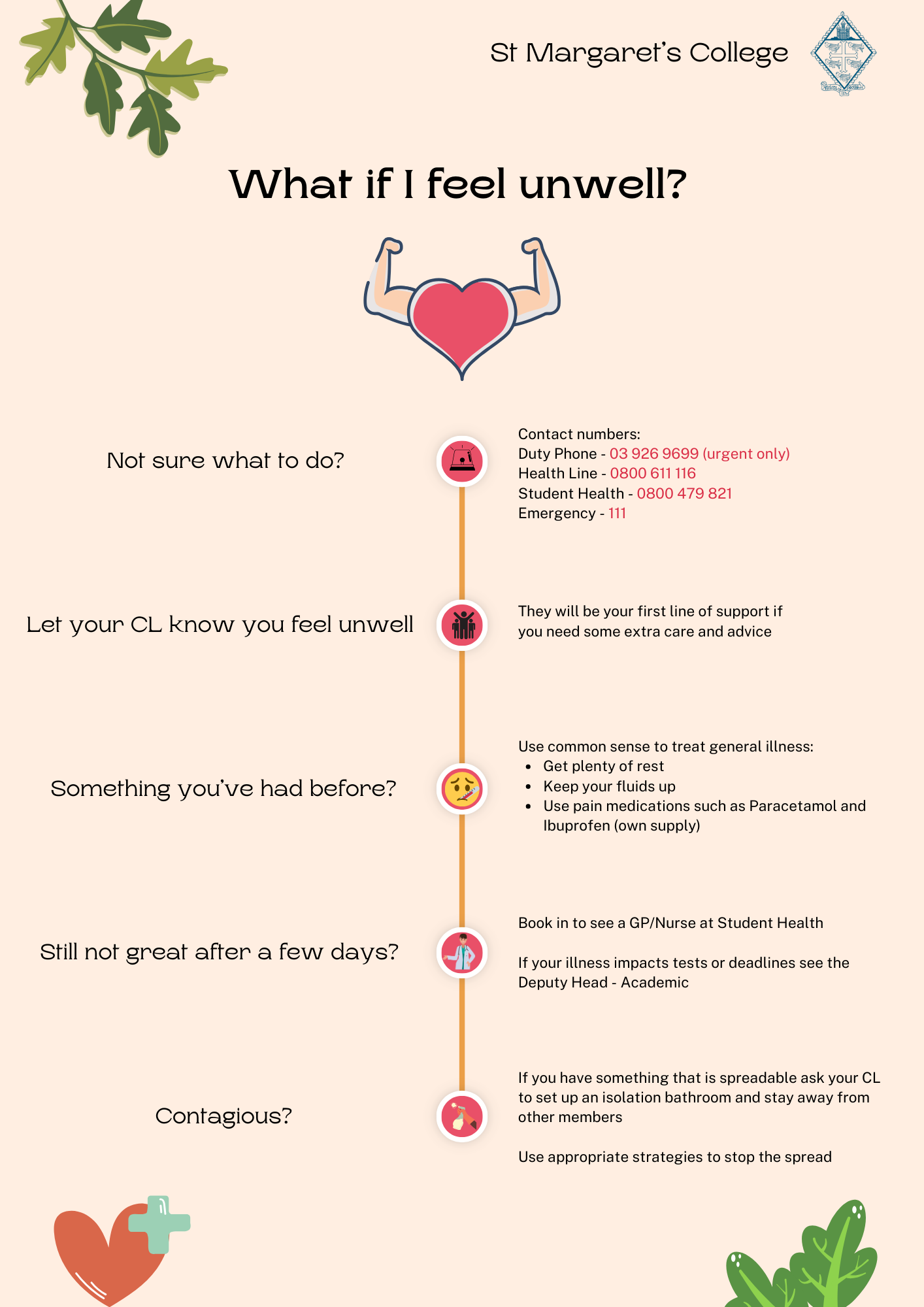
If a Member is ill, it is the responsibility of their floor's College Leader to arrange meals for them. Please add details of the illness to the relevant Slack channel so staff are aware.
Sometimes illness is the medical side of homesickness, loneliness, or panic. It must be remembered that a real medical problem exists but it is often brought about by the change in environment. Members of College have to adjust to a number of different things. On the psychological side, they have to adjust to a new group of people and missing their own family and friends. On the physiological side, they have to adjust to a different climate, shared bugs, and a disruption to their body clocks with different meal times. We will always have a certain amount of illness caused by these factors and the only way we can minimise it is to provide a caring and stable environment.
If a student becomes contagiously ill, it is advisable to put up a “Sick Bathroom” sign to prevent the illness from spreading.
Healthline (0800 611 116) is also a good source of advice if you are unsure about anything.